HPE GreenLake · Intelligence

The agentic AI architecture for autonomous hybrid cloud operations

GreenLake Intelligence is not just AI-ready — it's AI-operational. A mesh of intelligent agents collaborate, learn, reason, and act in real time across your hybrid estate, continuously optimizing, enforcing policy, and troubleshooting proactively, with humans in the loop.
Executive Summary

Beyond automation — operations with intelligence

Enterprise IT has reached a tipping point: as organizations scale across hybrid, multicloud, and edge environments, infrastructure complexity has outpaced human capacity. Static dashboards, disconnected tools, and reactive processes can no longer keep up. GreenLake Intelligence introduces a new paradigm — an agentic Artificial Intelligence (AI) architecture purpose-built for autonomous, enterprise-scale operations.

At a glance

Target workloadAutonomous hybrid cloud operations — agentic Artificial Intelligence for IT Operations (AIOps) across data center, cloud, and edge
InfrastructureThe HPE GreenLake platform plus HPE and third-party compute, storage (including HPE Alletra Storage MP), and networking
Interface / controlGreenLake application programming interfaces (APIs) — RESTful, secured with OAuth 2.0 and role-based access control (RBAC)
Key advantageA mesh of expert AI agents that reason, collaborate, and act in real time — with human-in-the-loop governance and full transparency

Traditional AIOps vs. agentic AIOps

Traditional Artificial Intelligence for IT Operations (AIOps) focuses on monitoring, analyzing, and automating with machine learning and pattern recognition. Agentic AIOps goes further — adding autonomy, contextual awareness, and proactive decision-making.

DimensionTraditional AIOpsAgentic AIOps (GreenLake Intelligence)
ApproachPredefined workflows, rules, and historical dataAutonomous, goal-driven intelligent agents
BehaviorMonitor, analyze, and react to anomaliesDynamically assess, adapt to real-time change, and act
Decision-makingPattern recognitionContextual autonomy and proactive decisions aligned to goals
LearningStatic modelsSelf-learning, task prioritization, cross-system collaboration
Human roleHuman-driven coordination across teamsHuman-in-the-loop with operator-defined autonomy and guardrails
Architectural Flow

Inside the GreenLake Intelligence agentic AI architecture

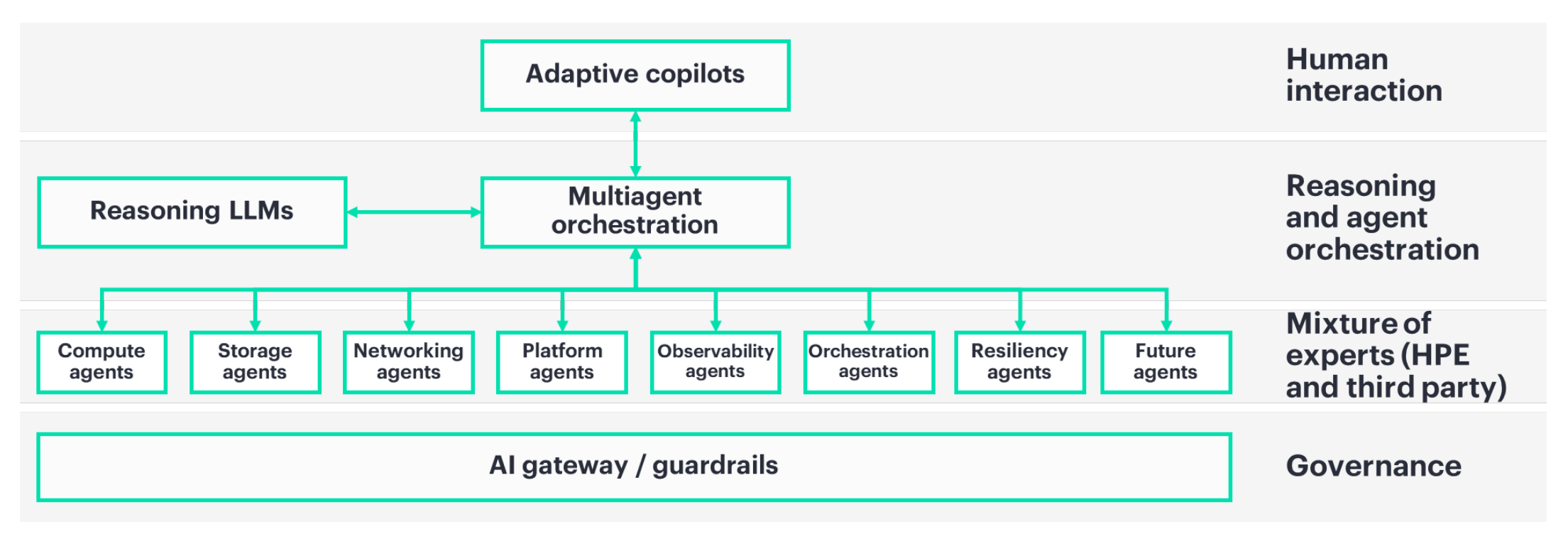
Four layers work together — humans interact through adaptive copilots; reasoning large language models (LLMs) drive multiagent orchestration; a mixture of domain expert agents acts on live telemetry; and an AI gateway enforces governance.

GreenLake Intelligence architecture: adaptive copilots, reasoning LLMs and multiagent orchestration, a mixture of expert agents, and an AI gateway for governance
LayerComponents & role
Human interactionAdaptive copilots — natural-language interaction, oversight, and operator-defined autonomy
Reasoning & orchestrationReasoning LLMs + multiagent orchestration — chain-of-thought across HPE and third-party agents with shared context, memory, and intent
Mixture of expertsCompute, storage, networking, platform, observability, orchestration, resiliency, and future agents (HPE and third party)
GovernanceAI gateway / guardrails — identity- and context-aware authentication of agent objectives and interactions

Design points

Operationalize collective intelligence at scale — without sacrificing trust, transparency, or control.

Human-in-the-loop

Analysts and engineers define high-level goals, constraints, and escalation protocols that agents interpret during decision cycles.

Interagent communication

Open industry protocols — including the Model Context Protocol (MCP) — standardize collaboration across HPE and third-party agents such as ServiceNow, Salesforce, and PagerDuty.

Contextual autonomy

Agents make intelligent decisions from real-time infrastructure metrics and business logic, on-array, in the data center, or at the edge.

Infrastructure-aware models

Agents can proactively request compute, storage, or network resources — or adjust fidelity — to cut cost, optimize performance, and hold service-level agreement (SLA) alignment.

Adaptable, goal-driven

Different goals can spawn different expert agents — designed to adapt to today's goals and future ones not yet known.

Transparency & oversight

Built-in governance and explainability help meet regulatory and ethical requirements as AI takes on mission-critical operations.

What is the Model Context Protocol (MCP)?

MCP is a framework that ensures AI models operate effectively by providing task-specific context — input parameters, user intent, or environmental data. It helps models adapt dynamically, align outputs with objectives, and stay relevant, improving accuracy, transparency, and reliability in AI-driven workflows.

A mixture of experts for goal flexibility

Expert agents are LLM-based, tuned to a task category, and fed domain-specific data — delivering value across day-0, day-1, and day-2 operations. Initial priority use cases:

Streamlined service delivery

Autonomous provisioning and workload balancing across cost, performance, and security parameters.

Workload & platform optimization

AI-driven workload placement, sustainability tuning, and capacity forecasting.

Proactive troubleshooting

Agents coordinate real-time root-cause analysis with embedded observability.

Use Case

How agentic AI resolves network latency in real time

HPE Aruba Networking Central leverages GreenLake Intelligence for security-first, AI-powered networking. In this example, unacceptable latency is impacting Slack for users at a site — a coordinated set of expert agents diagnoses and remediates it, with operator approval.

Five clients at site RS05 are experiencing a median latency of 101 milliseconds.

Identifies the switches and gateway in the path when clients access Slack.

Finds 38 contract lookup failures indicating recurring bandwidth contract resolution issues on the gateway; verifies that path switches CORE1 and AGG1 show no congestion, ruling them out.

Extracts the gateway configuration and discovers two bandwidth contracts set at only 512 Kbps each.

Applies the fix in real time — raising the bandwidth contracts to at least 5 Mbps to provide sufficient capacity for Slack and similar applications. The operator approves with a simple "OK" in the copilot; systems can be configured to act with greater or lesser independence based on enterprise policy.

Extensibility, ecosystem, and partner value

GreenLake Intelligence inherits the security, API frameworks, and validated partner ecosystem of GreenLake. GreenLake APIs use RESTful principles with OAuth 2.0 authentication and role-based access control (RBAC), so developers and independent software vendors (ISVs) can automate operations and build their own agents or copilots — in security, data protection, operations, and more.

Resource · Technical White Paper

GreenLake Intelligence: the agentic AI architecture

The full technical white paper — architecture, design points, the mixture-of-experts model, adaptive copilots, and an end-to-end network troubleshooting use case.

Get Started

Operate your hybrid estate with intelligence

Talk with an EdgeCloudStore specialist about bringing agentic AIOps to your environment with HPE GreenLake Intelligence — and how BlueAlly can help you deploy and operate it.